*Juliusz Kosewski1, Sylwia Plona2, Agnieszka Mielczarek1
Frequency and comparison of instrument lubrication procedures during composite resin modeling
Częstość i porównanie metod zwilżania narzędzi podczas modelowania kompozytów stomatologicznych
1Zakład Stomatologii Zachowawczej, Warszawski Uniwersytet Medyczny
Kierownik Zakładu: prof. dr hab. n. med. Agnieszka Mielczarek
1Department of Conservative Dentistry, Medical Unversity of Poland, Warsaw
Head of Department: Professor Agnieszka Mielczarek, MD, PhD
2Studenckie Koło Naukowe Zakładu Stomatologii Zachowawczej, Warszawski Uniwersytet Medyczny
Opiekun Koła: dr n. med. Ewa Rusyan
2Student Scientific Club of the Department of Conservative Dentistry, Medical University of Poland, Warsaw
Supervisor of the Club: Ewa Rusyan, MD
Streszczenie
Wstęp. Materiały kompozytowe często stanowią wyzwanie w modelowaniu i adaptacji ze względu na ich lepką konsystencję. Pomimo zaleceń producentów, stomatolodzy często stosują techniki zwilżania narzędzi za pomocą żywic do modelowania, środków wiążących lub alkoholu.
Cel pracy. Celem badania było określenie częstości stosowania oraz szczegółów techniki zwilżania narzędzi podczas modelowania wypełnień kompozytowych.
Materiały i metody. Przeprowadzono ankietę online wśród polskich lekarzy dentystów i studentów stomatologii w celu zgromadzenia informacji dotyczących nawyków i procedur zwilżania narzędzi podczas modelowania kompozytów stomatologicznych.
Wyniki. Spośród 557 respondentów (81,5% kobiet, 18,5% mężczyzn) 69,8% potwierdziło stosowanie technik zwilżania narzędzi, przy czym wśród lekarzy dentystów odsetek ten wyniósł 75%, a wśród studentów stomatologii – 41%. Lekarze dentyści stosowali głównie dedykowane żywice do modelowania (64,5%), podczas gdy studenci preferowali systemy łączące Total-Etch (48%). Najczęściej zwilżane narzędzia to: pędzelki (36%), mikroaplikatory (35%) i narzędzia metalowe (29%). Około 46% ankietowanych wycierało nadmiar lubrykantu, najczęściej o rękawiczkę (40%) lub w suchą gazę (40%).
Wnioski. Badanie wykazało istotną korelację między etapem kariery a zwilżaniem narzędzi, wskazując na ograniczone uwzględnienie tej techniki w edukacji stomatologicznej. Brak standaryzacji substancji i technik zwilżania stanowi wyzwanie – podczas gdy technika ta ułatwia manipulację kompozytem, może również wpływać na właściwości materiału i stwarzać ryzyko zawodowe, takie jak reakcje alergiczne na metakrylany podczas wycierania nadmiarów o rękawiczkę.
Podsumowując, zwilżanie narzędzi jest powszechne w praktyce stomatologicznej, co może mieć potencjalne konsekwencje dla efektów leczenia przy użyciu odbudów kompozytowych.
Summary
Introduction. Dental composite resins often pose challenges in modeling and adaptation due to their viscous consistency. Despite manufacturer recommendations, dentists commonly employ lubrication techniques using modeling resins, bonding agents, or alcohol.
Aim. Aim of this study was to examine the usage and implications of instrument lubrication during dental composite restoration placement.
Material and methods. An online survey was conducted among Polish dental practitioners to assess their habits and gather information on instrument lubrication procedures.
Results. Out of 557 respondents (81.5% female, 18.5% male), 69.8% reported using instrument lubrication techniques, with dentists at 75% and dental students at 41%. Dentists primarily used dedicated modeling resins (64.5%), while students preferred total-etch adhesives (48%). Commonly wetted instruments included brushes (36%), microbrushes (35%), and metal tools (29%). Around 46% of respondents wiped off excess lubricant, mostly using a glove (40%) or dry gauze (40%).
Conclusions. The study revealed a significant correlation between career stage and instrument lubrication usage, indicating limited incorporation of the technique in dental education. However, the lack of standardization in lubrication substances and techniques poses challenges. While lubrication facilitates composite manipulation, it may also alter material properties and pose occupational risks, such as allergic reactions from methacrylate exposure during glove wiping. In summary, instrument lubrication is prevalent in dental practice, with potential implications for composite restoration outcomes.
Słowa kluczowe: kompozyty stomatologiczne, wypełnienia stomatologiczne, żywice do modelowania, zwilżanie narzędzi, modelowanie kompozytu
Introduction
Dental composite resins possess a viscous consistency that can hinder the accurate modeling of anatomical contours and the proper adaptation of the material to the walls of cavities (1). To overcome the issue of the composite sticking to hand instruments, it has become common practice to lubricate the instruments with modeling resins, bonding agents, or alcohol (2-4). It’s worth noting that this approach goes against the recommendations of most manufacturers, as it has the potential to alter the characteristics of the restorative material. Some authors even caution against this technique, as it may disrupt the composition of the modeled composite layer and affect the material’s properties (5, 6).
Although known as a common practice, there is no precise scientific evidence regarding the extent of the use of the instrument lubrication technique by dentists.
Aim
Aim of the study was to gather the information about the prevalence and details of instrument lubrication technique among Polish dental practitioners and to assess their habits during composite restoration placement.
Material and methods
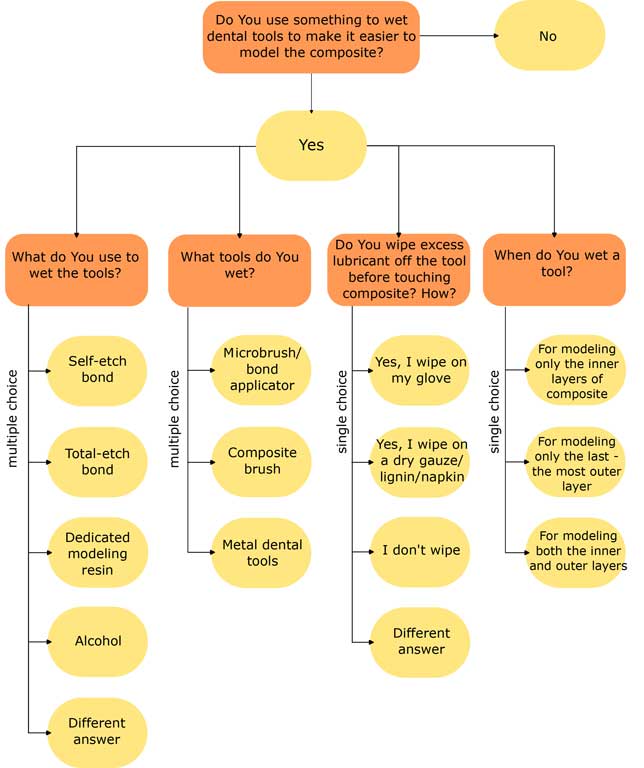
An online survey was conducted among a group of polish dentists and dental students, utilizing a non-interventional questionnaire to gather data on the prevalence of wetting tools during composite modeling in the dental community. The form contained of 7 questions, 3 questions – about the career stage, gender and whether the person wets the tools – were asked to each survey participant and 4 questions about the steps and materials used in the procedure were asked only to participants who confirmed to wet the tools. Questions and answers regarding the instrument lubrication technique can be seen in figure 1.
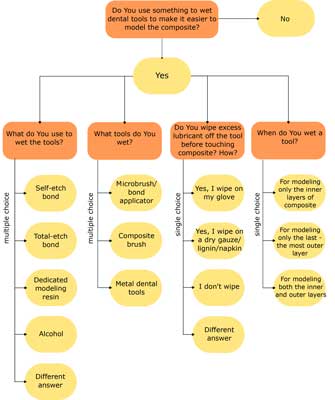
Fig. 1. Survey structure – questions regarding instrument lubrication technique
The survey was conducted online. Respondents who completed the online survey accessed the questionnaire via a link in an email, on Messenger or through Facebook groups dedicated to dentists and dental students. The data was collected by using a specially prepared Google Forms questionnaire. People who completed the survey did not have the opportunity to ask additional questions about the study.
The study included dental practitioners, consisting of two subgroups: dentists and dental students.
Respondents were required to spend approximately one minute to complete the questionnaire. The study did not involve any financial compensation for participants.
Results were then analyzed using PQ Stat (2023) statistical software (PQStat Software, Poland).
Ethical approval for this study was provided by the Ethical Committee of Medical University of Warsaw (decision AKBE/297/2023).
Results
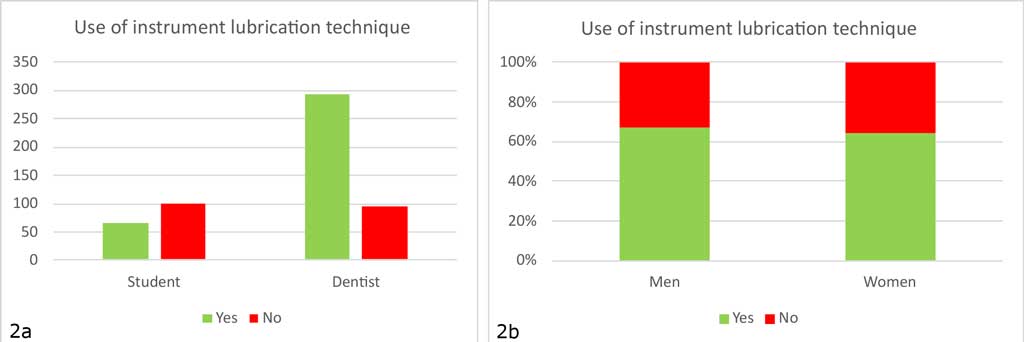
Survey was completed by 557 people, including 454 women (81.5%) and 103 men (18.5%). Among the respondents, 389 individuals (69.8%) held the professional title of dentist, while 168 (30.2%) were dental students. When considering all the responses, 65% declared the use of the instrument wetting technique during composite work. Among dentists, this percentage was 75%, while among students it was 41% (fig. 2a,b). Fisher’s exact test was used to determine if there is a correlation between career stage and the use of the instrument wetting technique. There was a statistically significant association between the two tested variables (two tailed p < 0.000001). However, no statistically significant association was found between gender and instrument wetting using the same test (two tailed p = 0.65) (tab. 1).
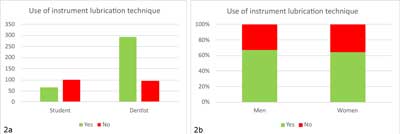
Fig. 2a, b. Responses regarding the use of instrument lubrication technique depending on the career stage (a) and gender (b)
Tab. 1. Cross table presenting responses about the use of instrument lubrication technique depending on the career stage and gender
Use of lubricant
Career stage | Yes | No | Total |
| Students | 67 (39.90%) | 101 (60.10%) | 168 (100%) |
| Dentists | 293 (75.30%) | 96 (24.70%) | 389 (100%) |
| Total | 360 (100%) | 197 (100%) | 557 (100%) |
| Fisher exact test two-tailed p value < 0.000001 |
| Gender | | | |
| Men | 69 (67%) | 34 (33%) | 103 (100%) |
| Women | 291 (64.1%) | 163 (35.9%) | 454 (100%) |
| Total | 360 (100%) | 197 (100%) | 557 (100%) |
| Fisher exact test two-tailed p value = 0.64832 |
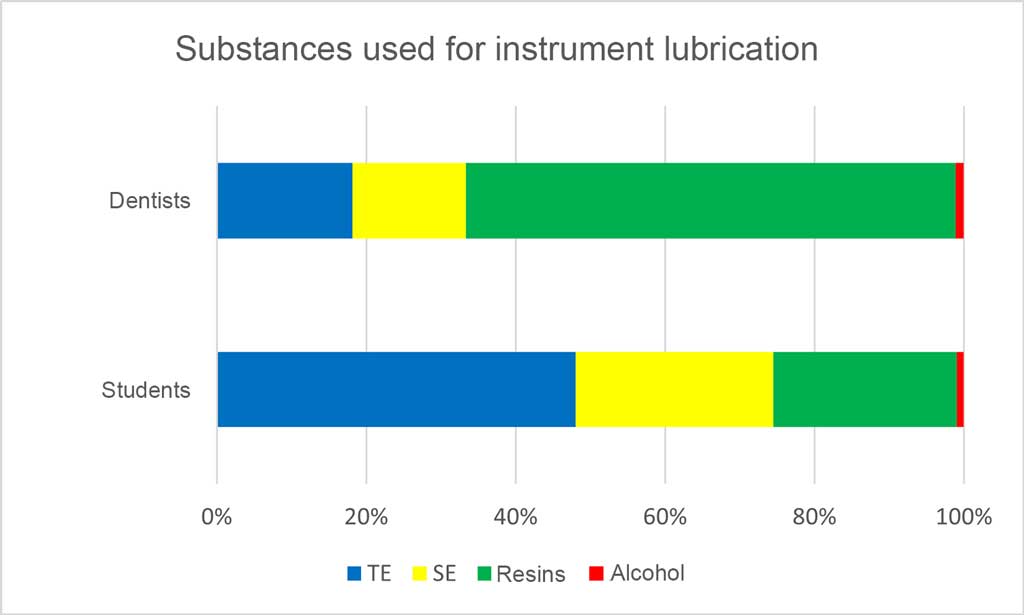
The frequency of using different materials for instrument wetting is shown in fig. 3. Among the surveyed dentists, 64.5% declared using dedicated resins for modeling, 18.2% mentioned the use of total-etch adhesives, 15.2% used self-etch adhesives, and only 1.1% used alcohol. Among students, the most frequently declared wetting substance was total-etch adhesives (48%), followed by self-etch adhesives (26.5%), dedicated resins for modeling (24.5%), and alcohol (1%).
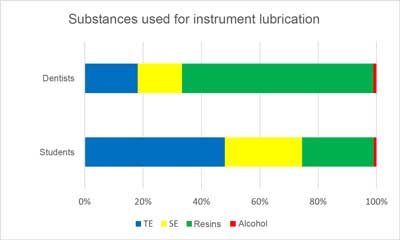
Fig. 3. Responses about the substances used for instrument lubrication depending on the career stage. TE – total etch bonds; SE – self-etch bonds; Resins – dedicated modeling resins
Powyżej zamieściliśmy fragment artykułu, do którego możesz uzyskać pełny dostęp.
Mam kod dostępu
- Aby uzyskać płatny dostęp do pełnej treści powyższego artykułu albo wszystkich artykułów (w zależności od wybranej opcji), należy wprowadzić kod.
- Wprowadzając kod, akceptują Państwo treść Regulaminu oraz potwierdzają zapoznanie się z nim.
- Aby kupić kod proszę skorzystać z jednej z poniższych opcji.
Opcja #1
24 zł
Wybieram
- dostęp do tego artykułu
- dostęp na 7 dni
uzyskany kod musi być wprowadzony na stronie artykułu, do którego został wykupiony
Opcja #2
59 zł
Wybieram
- dostęp do tego i pozostałych ponad 7000 artykułów
- dostęp na 30 dni
- najpopularniejsza opcja
Opcja #3
119 zł
Wybieram
- dostęp do tego i pozostałych ponad 7000 artykułów
- dostęp na 90 dni
- oszczędzasz 58 zł
Piśmiennictwo
1. Al-Sharaa KA, Watts DC: Stickiness prior to setting of some light cured resin-composites. Dent Mater 2003; 19(3): 182-187.
2. Liebenberg WH: Bonding agent as an instrument lubricant: potential effect on marginal integrity. Pract Periodontics Aesthet Dent 1999; 11(4): 475-478.
3. Tjan AH, Glancy JF: Effects of four lubricants used during incremental insertion of two types of visible light-activated composites. J Prosthet Dent 1988; 60(2): 189-194.
4. Ferracane JL, Hilton TJ, Stansbury JW et al.: Academy of Dental Materials guidance – Resin composites: Part II. Technique sensitivity (handling, polymerization, dimensional changes). Dent Mater 2017; 33(11): 1171-1191.
5. Barcellos DC, Palazon M, Pucci CR et al.: Effects of Self-Etching Adhesive Systems Used in the Dental Modelling Technique on the Cohesive Strength of Composite Resin. J Adhes 2011; 87(2): 154-161.
6. Melo AM, Santos T, Tertulino M et al.: Degree of Conversion, Translucency and Intrinsic Color Stability of Composites During Surface Modeling With Lubricants. Braz J Oral Sci 2018; 17: 1-11.
7. Kosewski J, Kosewski P, Mielczarek A: Influence of Instrument Lubrication on Properties of Dental Composites. Eur J Dent 2022; 16(4): 719-728.
8. Ritter AV, Walter R, Boushell LW, Ahmed SN: 8 – Clinical Technique for Direct Composite Resin and Glass Ionomer Restorations. [In:] Ritter AV, Boushell LW, Walter R (eds.): Sturdevant’s Art and Science of Operative Dentistry. St. Louis: Elsevier 2019: 219-263.
9. Kutuk ZB, Erden E, Aksahin DL et al.: Influence of modeling agents on the surface properties of an esthetic nano-hybrid composite. Restor Dent Endod 2020; 45(2): e13.
10. Patel J, Granger C, Parker S, Patel M: The effect of instrument lubricant on the diametral tensile strength and water uptake of posterior composite restorative material. J Dent 2017; 56: 33-38.
11. Hamouda I: Effect of Instrument Lubricant on Water Sorption and Solubility of Incrementally Applied Nanofilled Resin Composite. Nanotechnology: Nanomedicine & Nanobiotechnology 2017; 4: 1-4.
12. Nassar H, El-Shamy H: Bonding System Choice and Practices among Senior Dental Students. J Int Soc Prev Community Dent 2017; 7(suppl. 3): S143-s148.
13. Tuncer S, Demirci M, Tiryaki M et al.: The effect of a modeling resin and thermocycling on the surface hardness, roughness, and color of different resin composites. J Esthet Restor Dent 2013; 25(6): 404-419.
14. Bayraktar ET, Atali PY, Korkut B et al.: Effect of Modeling Resins on Microhardness of Resin Composites. Eur J Dent 2021; 15(3): 481-487.
15. Kakuta K, Wonglamsam A, Goto S-I, Ogura H: Surface textures of composite resins after combined wear test simulating both occlusal wear and brushing wear. Dent Mater J 2012; 31(1): 61-67.
16. Turssi CP, Ferracane JL, Serra MC: Abrasive wear of resin composites as related to finishing and polishing procedures. Dent Mater 2005; 21(7): 641-648.
17. Sananez A, Sanchez A, Davis L et al.: Allergic reaction from dental bonding material through nitrile gloves: Clinical case study and glove permeability testing. J Esthet Restor Dent 2020; 32(4): 371-379.
18. Aalto-Korte K, Alanko K, Kuuliala O, Jolanki R: Methacrylate and acrylate allergy in dental personnel. Contact Dermatitis 2007; 57(5): 324-330.
19. Martins NM, Schmitt GU, Oliveira HL et al.: Contamination of Composite Resin by Glove Powder and Saliva Contaminants: Impact on Mechanical Properties and Incremental Layer Debonding. Oper Dent 2015; 40(4): 396-402.